Jeevan’s pandemic preparations
Station ElevenJeevan Chaudhary’s pandemic preparations begin when a trusted friend’s warning turns a distant outbreak into an immediate threat. Acting on incomplete news and his own improvised ideas about survival, he fills seven shopping carts with provisions and carries them to his brother Frank’s apartment. The episode shows both the urgency of his response and its limits: he can gather supplies and try to secure a home, but he cannot restore the systems that are already failing or make the danger outside disappear.
The Warning and Its Consequences
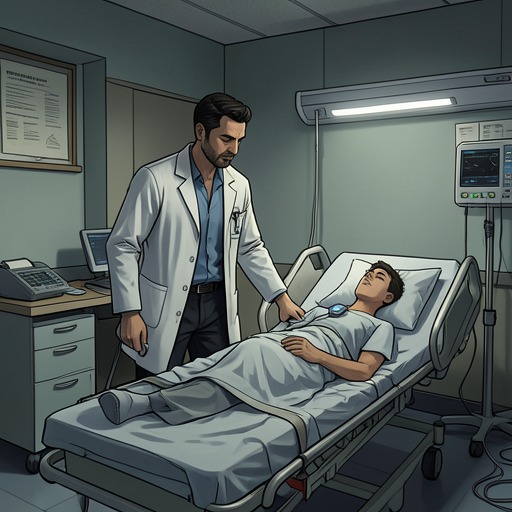
Hua tells Jeevan that Toronto hospitals have admitted more than two hundred flu patients since morning, including 160 in the preceding three hours, and that fifteen have died. The emergency department is full, beds have been placed in hallways, and Health Canada is about to make an announcement. Hua’s fear matters to Jeevan as much as the numbers: because Hua is a close friend and is not given to exaggeration, the warning makes the scale of the crisis difficult to dismiss.
After leaving the streetcar, Jeevan calls Hua again. Hua describes the illness as a full-scale epidemic and advises him to leave the city or, if he cannot, to stock up on food and stay in his apartment. Jeevan understands the warning as a rupture in time, a divide between the life that came before and the one that is beginning. He turns toward Frank’s building, then goes into a grocery store by the harbour, intending to check the news and contact people he knows once he reaches his brother.
A television above the film-development counter reports that Toronto General Hospital and two other local hospitals have been placed under isolation, and that Health Canada has confirmed an outbreak of the Georgia Flu. Fatalities are known, though officials are not yet releasing figures. The broadcast also suggests that officials in Georgia and Russia had not fully disclosed the severity of the crisis. Its request that the public remain calm contrasts with the news itself: Jeevan now has both Hua’s urgent account and public confirmation that the outbreak has reached Toronto.
The Supply Run
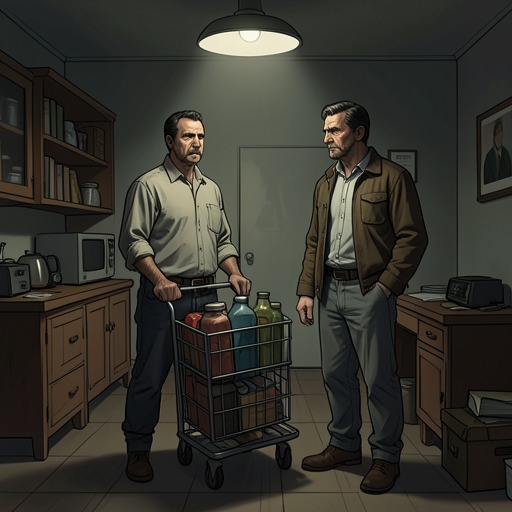
Jeevan’s practical model for disaster preparedness comes from action movies, but he begins with water, loading cases and bottles into an oversized cart. The weight makes him doubt his judgment as he approaches the registers, yet he continues. At 11:20 p.m., with the supermarket due to close in forty minutes, he leaves the cart outside temporarily and returns to the store for more provisions. He calls Hua while moving through the aisles, buying another case of water and then cans of tuna, beans, and soup, along with pasta and other food that seems likely to keep.
Hua reports that the situation is similar at the other hospitals and that the ambulance service is overwhelmed. The death toll has reached thirty-seven; among the dead are all the patients who arrived on the Moscow flight and two emergency-room nurses who were on duty when the first patients came in. Hua says he has told his wife to take their children out of the city that night, but not by airplane. The information gives Jeevan’s shopping a practical urgency while also showing how quickly ordinary means of transport and care are becoming uncertain.
On further trips he adds toilet paper, more canned food, frozen meat, Aspirin, garbage bags, bleach, and duct tape. He makes several trips through the store, at one point telling the cashier that he works for a charity. On his sixth trip he calls Laura, but reaches her voicemail. When he warns a cashier that she should leave the city, she compares the outbreak to SARS; she appears frightened by his insistence and also regards him as irrational. By the time the store closes, Jeevan is outside with seven enormous carts, exhausted, cold, and unsure how he will move them through the snow.
Securing Frank’s Apartment
It takes most of an hour to push the carts through the snow and into Frank’s building. Jeevan has to bribe the night doorman to use the freight elevator without authorization, then moves the supplies upstairs in shifts to the twenty-second floor. His explanation that he is a survivalist sounds wild even to him, but the elevator and the accumulated provisions make the warning tangible: he is preparing not for a brief inconvenience but for a period of confinement.
In the days that follow, the apartment becomes a defensive refuge. Jeevan and Frank watch low-volume television news, its reports of mounting deaths blurring into a continuing litany of disaster. Jeevan tapes plastic over the air ducts, uncertain whether the virus could get around the edges, hangs Frank’s bath towels over the windows to prevent light from escaping at night, and pushes a dresser against the door. When people knock, the brothers fall silent. Twice someone tries to force the lock with a metal tool; the deadbolt holds. The preparations are therefore not simply a stockpile: they extend to controlling air, light, access, and contact with other people.
The Limits of Preparation
The supplies and barricades do not restore a functioning city. Jeevan becomes afraid of people beyond the apartment, while the news grows so relentless that it begins to seem unreal. The contrast between the first frantic shopping trips and the days of guarded silence measures the change in his circumstances: gathering food is an action he can take, but it cannot offer certainty about infection or safety.
When Jeevan later prepares to leave, he resolves to follow the lakeshore rather than use the roads, which he wants to avoid if possible. From Frank’s apartment he has watched the expressway through a telescope and seen only two people, both moving away from downtown. He is also attentive to Frank’s silence in the next room and checks twice that his brother is breathing. The move from stocked apartment to cautious travel shows the boundary of the original plan: the provisions bought time and shelter, but they could not make staying indefinitely possible. The preparations stand as Jeevan’s first concrete response to the collapse, resourceful and sustained, yet always shadowed by what no cart, barricade, or supply could control.